CUET Chemistry Important Questions PDF 2026 | Free Download – Tejana Classes
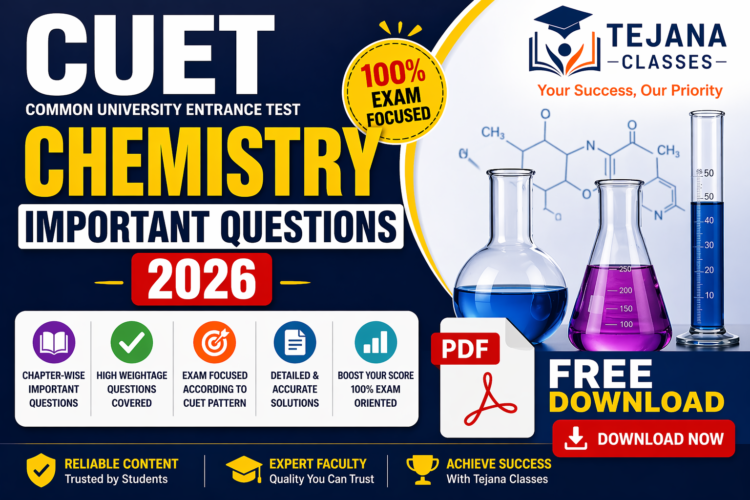
क्या आप CUET 2026 Chemistry की तैयारी कर रहे हैं और CUET Chemistry Important Questions PDF ढूंढ रहे हैं? तो आप बिल्कुल सही जगह पर आए हैं। इस Post में हम आपको Chapter-wise CUET Chemistry Important Questions देंगे जो आपकी Exam Preparation को बेहद आसान बना देंगे।
CUET (Common University Entrance Test) में Chemistry एक Domain-Specific Subject है जिसे लाखों Students चुनते हैं। अगर आप B.Sc Chemistry, B.Sc Biotechnology या किसी Science Stream में Central University में Admission चाहते हैं तो CUET Chemistry में अच्छे Marks लाना जरूरी है।
इस Post में आपको मिलेगा:
- ✅ CUET Chemistry Exam Pattern 2026
- ✅ Chapter-wise Important Questions (Physical, Organic, Inorganic)
- ✅ Most Expected MCQs with Answers
- ✅ Preparation Tips & Strategy
- ✅ Free PDF Download Link
CUET Chemistry Exam Pattern 2026
CUET Chemistry Important Questions PDF समझने से पहले आपको Exam Pattern जरूर जानना चाहिए ताकि आप सही Direction में तैयारी कर सकें।
| विवरण | जानकारी |
|---|---|
| Exam का नाम | CUET UG 2026 – Chemistry (Domain Subject) |
| Conducting Body | NTA (National Testing Agency) |
| कुल प्रश्न | 50 प्रश्न |
| Attempt करने होंगे | 40 प्रश्न |
| अधिकतम अंक | 200 अंक |
| समय | 45 मिनट |
| Marking Scheme | +5 सही उत्तर पर, -1 गलत उत्तर पर |
| प्रश्नों का प्रकार | MCQ (बहुविकल्पीय प्रश्न) |
| Syllabus आधार | NCERT Class 12 Chemistry |
💡 Important Tip: CUET Chemistry में Negative Marking होती है इसलिए केवल उन्हीं प्रश्नों को Attempt करें जिनका उत्तर आप सुनिश्चित हों।
CUET Chemistry Chapter-wise Weightage 2026
CUET Chemistry में 16 Units हैं जो तीन भागों — Physical, Inorganic और Organic Chemistry — में विभाजित हैं। नीचे Chapter-wise Expected Weightage दी गई है:
| Chapter / Unit | Category | Expected Questions |
|---|---|---|
| Solutions (विलयन) | Physical | 2–3 |
| Electrochemistry (विद्युत रसायन) | Physical | 3–4 |
| Chemical Kinetics (रासायनिक बलगतिकी) | Physical | 2–3 |
| Surface Chemistry (पृष्ठ रसायन) | Physical | 1–2 |
| d & f Block Elements | Inorganic | 3–4 |
| Coordination Compounds | Inorganic | 3–4 |
| p-Block Elements | Inorganic | 2–3 |
| Haloalkanes & Haloarenes | Organic | 3–4 |
| Alcohols, Phenols & Ethers | Organic | 2–3 |
| Aldehydes, Ketones & Carboxylic Acids | Organic | 3–4 |
| Amines (ऐमीन) | Organic | 1–2 |
| Biomolecules (जैव अणु) | Organic | 2–3 |
| Polymers (बहुलक) | Organic | 1–2 |
| Chemistry in Everyday Life | Organic | 1–2 |
CUET Chemistry Important Questions – Physical Chemistry
1. Solutions (विलयन) – Important MCQs
Solutions Chapter से Colligative Properties, Raoult’s Law और Molarity पर Numerical प्रश्न पूछे जाते हैं।
- वह विलयन जो Raoult’s नियम का पालन करता है, कहलाता है — Ideal Solution (आदर्श विलयन)
- किसी विलायक का वाष्प दाब विलेय मिलाने पर — घट जाता है
- Osmotic Pressure का सूत्र है — π = CRT
- Azeotropic Mixture क्या होता है? — वह मिश्रण जो समान Composition पर उबलता है
- Ebullioscopic Constant (Kb) किस पर निर्भर करता है? — विलायक की प्रकृति पर
- Van’t Hoff Factor (i) का मान Electrolyte के लिए — 1 से अधिक होता है
- Henry’s Law किससे संबंधित है? — गैस की Solubility और Pressure से
- Molal Elevation Constant का SI मात्रक है — K·kg·mol⁻¹
2. Electrochemistry (विद्युत रसायन) – Important MCQs
यह CUET Chemistry का सबसे अधिक प्रश्न पूछा जाने वाला Chapter है। Nernst Equation, EMF, और Faraday’s Laws से Numerical अवश्य आते हैं।
- Nernst Equation है — E = E° − (RT/nF) ln Q
- Standard Hydrogen Electrode की Potential होती है — 0.00 V
- Kohlrausch का नियम किससे संबंधित है? — Molar Conductivity और Concentration से
- Faraday का प्रथम नियम — Electrode पर जमा द्रव्यमान विद्युत आवेश के समानुपाती होता है
- Daniel Cell में Anode पर होती है — Zn का Oxidation
- Electrolytic Cell में ऊर्जा का रूपांतरण होता है — Electrical → Chemical
- Galvanic Cell में ऊर्जा का रूपांतरण — Chemical → Electrical
- Conductance की SI Unit है — Siemens (S)
3. Chemical Kinetics (रासायनिक बलगतिकी) – Important MCQs
- Zero Order Reaction में Rate — Reactant Concentration पर निर्भर नहीं करती
- First Order Reaction के लिए Half Life — t½ = 0.693/k
- Activation Energy बढ़ाने पर Reaction Rate — घट जाती है
- Arrhenius Equation है — k = Ae^(−Ea/RT)
- Molecularity और Order में अंतर — Molecularity हमेशा Whole Number, Order Fractional भी हो सकती है
- Catalyst Reaction को — Activation Energy घटाकर तेज करता है
- Rate Constant की Unit Second Order Reaction में — L·mol⁻¹·s⁻¹
CUET Chemistry Important Questions – Inorganic Chemistry
4. d & f Block Elements – Important MCQs
इस Chapter से Transition Metals की Properties, Colour, और Magnetic Behaviour से प्रश्न आते हैं।
- Transition Elements की विशेषता है — अपूर्ण d-Orbital
- सबसे अधिक Oxidation States दिखाने वाला Element — Manganese (Mn)
- Lanthanide Contraction का कारण — f-Orbitals की Poor Shielding
- KMnO₄ Acidic Medium में कार्य करता है — Oxidizing Agent
- Chromate और Dichromate में रूपांतरण — pH परिवर्तन से होता है
- Actinides सब होते हैं — Radioactive
- Cu का Electronic Configuration — [Ar] 3d¹⁰ 4s¹ (अपवाद)
5. Coordination Compounds – Important MCQs
- IUPAC नाम में Ligands को — Alphabetically लिखते हैं
- [Fe(CN)₆]⁴⁻ में Fe की Oxidation State — +2
- Werner Theory के अनुसार Primary Valency — Ionizable होती है
- EAN Rule (Effective Atomic Number) किसने दिया? — Sidgwick ने
- Chelate Complex बनाने वाले Ligands — Polydentate Ligands
- Crystal Field Theory में d-Orbitals का विभाजन होता है — Crystal Field के कारण
- [Co(NH₃)₆]³⁺ में Co की Coordination Number — 6
CUET Chemistry Important Questions – Organic Chemistry
6. Haloalkanes & Haloarenes – Important MCQs
- SN2 Reaction में — Inversion of Configuration होती है (Walden Inversion)
- SN1 Reaction सबसे तेज होती है — Tertiary Haloalkanes के साथ
- Chlorobenzene में Chlorine Ring को करता है — Deactivate, लेकिन o- और p- Director है
- Freon का रासायनिक नाम — Chlorofluorocarbon (CFC)
- DDT का पूरा नाम — Dichlorodiphenyltrichloroethane
- Haloarenes में C–X Bond, Haloalkanes से — छोटी और अधिक मजबूत होती है
7. Alcohols, Phenols & Ethers – Important MCQs
- Lucas Test किसके लिए होता है? — Alcohols की Primary, Secondary, Tertiary पहचान के लिए
- Phenol का Acidic Character Alcohol से — अधिक होता है
- Williamson Synthesis से बनता है — Ether
- Glycerol कितने −OH Group वाला Alcohol है? — Trihydric (3 −OH)
- Phenol FeCl₃ से देता है — Violet Color (Purple)
8. Aldehydes, Ketones & Carboxylic Acids – Important MCQs
- Aldol Condensation होती है — Aldehyde या Ketone के α-H के साथ Base की उपस्थिति में
- Tollens’ Reagent से Silver Mirror देता है — Aldehyde (Ketone नहीं)
- Fehling’s Solution Reduce करता है — Aliphatic Aldehyde
- Carboxylic Acid की Acidity Phenol से — अधिक होती है
- Cannizzaro Reaction होती है — बिना α-H वाले Aldehyde में
- Acetaldehyde का IUPAC नाम — Ethanal
9. Biomolecules – Important MCQs
- Cellulose के Hydrolysis से मिलता है — β-D-Glucose
- Lactose बना होता है — Glucose + Galactose से
- Tyndall Effect दिखाता है — Colloid (कोलाइड)
- DNA में मौजूद Bases — Adenine, Thymine, Guanine, Cytosine
- RNA में Thymine की जगह होता है — Uracil
- Insulin एक — Protein Hormone है
- Vitamins जो Fat-Soluble हैं — A, D, E, K
CUET Chemistry 2026 की तैयारी कैसे करें?
अगर आप CUET Chemistry में 180+ Score लाना चाहते हैं तो नीचे दी गई Strategy को Follow करें:
📚 Step 1: NCERT पर Focus करें
CUET Chemistry के लगभग 85–90% प्रश्न सीधे NCERT Class 11 और 12 से आते हैं। NCERT की हर Line, Example, और In-Text Questions को ध्यान से पढ़ें।
📝 Step 2: Chapter-wise Notes बनाएं
हर Chapter के Important Points, Formulas, Reactions, और Named Reactions को Short Notes में लिखें। यह Revision के समय बहुत काम आता है।
🧪 Step 3: Organic Chemistry की Reactions याद करें
Organic Chemistry में Reactions और Mechanisms बहुत Important हैं। SN1, SN2, Aldol, Cannizzaro, Williamson जैसी Named Reactions को जरूर याद करें।
🔢 Step 4: Physical Chemistry के Numericals Practice करें
Electrochemistry, Solutions, और Chemical Kinetics में Numerical बहुत Important हैं। रोज कम से कम 10 Numerical Practice करें।
📊 Step 5: Mock Tests दें
पिछले 3–4 साल के CUET Chemistry Previous Year Question Papers Solve करें और हर Week एक Full Mock Test दें।
🎯 Target Strategy: Physical Chemistry = 12-13 Questions Correct, Inorganic = 10-11 Questions, Organic = 14-15 Questions → Total 36-39/40 = 180-195+ Marks
CUET Chemistry के लिए Best Books 2026
| Book का नाम | उपयोग |
|---|---|
| NCERT Chemistry Class 11 & 12 | Main Reference (सबसे जरूरी) |
| NTA CUET Chemistry Practice Sets | MCQ Practice के लिए |
| CUET UG Chemistry Guide – Arihant | Comprehensive Practice |
| Previous Year Papers (2022–2025) | Pattern समझने के लिए |
CUET Chemistry Important Questions PDF Download 2026
नीचे दिए गए Button पर Click करके CUET Chemistry Important Questions PDF Free में Download करें। इस PDF में शामिल हैं:
- ✅ Chapter-wise 200+ Important MCQs with Answers
- ✅ Physical, Organic & Inorganic Chemistry Questions
- ✅ Named Reactions List
- ✅ Important Formulas & Short Notes
- ✅ Previous Year Memory Based Questions (2022-2025)
📥 CUET Chemistry PDF Download करें – FREE
निष्कर्ष (Conclusion)
CUET Chemistry Important Questions PDF 2026 आपकी Exam Preparation के लिए एक बहुत जरूरी Resource है। इस Post में दिए गए सभी Chapter-wise Questions को ध्यान से पढ़ें, Formulas याद करें और रोज Practice करें।
याद रखें — CUET Chemistry की तैयारी का मूल मंत्र है: NCERT पढ़ो, MCQs Practice करो, और Negative Marking से बचो।
अगर आपको यह Post helpful लगी तो इसे अपने दोस्तों के साथ Share करें और Tejana Classes को Bookmark करें ताकि आपको आगे के Important Study Material मिलते रहें।
📌 Tejana Classes पर आपको RBSE, CUET, REET, RAS और सभी Competitive Exams का Free Study Material मिलता है। tejanaclasses.com/ को Visit करते रहें।
अक्सर पूछे जाने वाले प्रश्न (FAQ)
Q1. CUET Chemistry में कुल कितने प्रश्न आते हैं?
CUET Chemistry में कुल 50 प्रश्न होते हैं जिनमें से 40 प्रश्न Attempt करने होते हैं। Marking: +5 सही पर, −1 गलत पर। अधिकतम Score 200 अंक है।
Q2. CUET Chemistry के लिए कौन-सी Book सबसे अच्छी है?
NCERT Class 11 & 12 Chemistry सबसे अच्छी है। लगभग 90% Questions NCERT से ही आते हैं। साथ में CUET Practice Sets और Previous Year Papers भी पढ़ें।
Q3. CUET Chemistry का Exam Pattern क्या है?
CUET Chemistry में MCQ Format में 50 प्रश्न होते हैं, 40 Attempt करने होते हैं, समय 45 मिनट, अधिकतम अंक 200, Negative Marking 1 अंक प्रति गलत उत्तर।
Q4. CUET Chemistry में सबसे ज्यादा प्रश्न किस Chapter से आते हैं?
Electrochemistry, Chemical Kinetics, Coordination Compounds, Haloalkanes, Aldehydes & Ketones और d & f Block Elements से सबसे ज्यादा प्रश्न पूछे जाते हैं।
Q5. CUET Chemistry Important Questions PDF Free में कहाँ से Download करें?
Tejana Classes (tejanaclasses.com/) पर CUET Chemistry Important Questions PDF बिल्कुल Free में Download कर सकते हैं। ऊपर दिए गए Download Button पर Click करें।
Download Study Material
Get the comprehensive PDF notes for this topic.